


Assembly August
We held a virtual turning competition in August 2020 (as we couldn't meet face-to-face due to the Covid-19 coronavirus pandemic). The title was "Assembly August", and the theme was "A piece constructed from multiple timbers". Here are the results.
The competition was judged independently and anonymously by Adrian King and Richard Peers. We were judging on four categories: Brief, Form, Function and Finish. The committee decided not to publish the scores, but to show the entry photographs and a summary of the judges' comments for each entry. We received a total of 7 entries.
| Member | Image | Judges' Comments | |||
|---|---|---|---|---|---|
| Brief | Form | Function | Finish | ||
| John Buck | 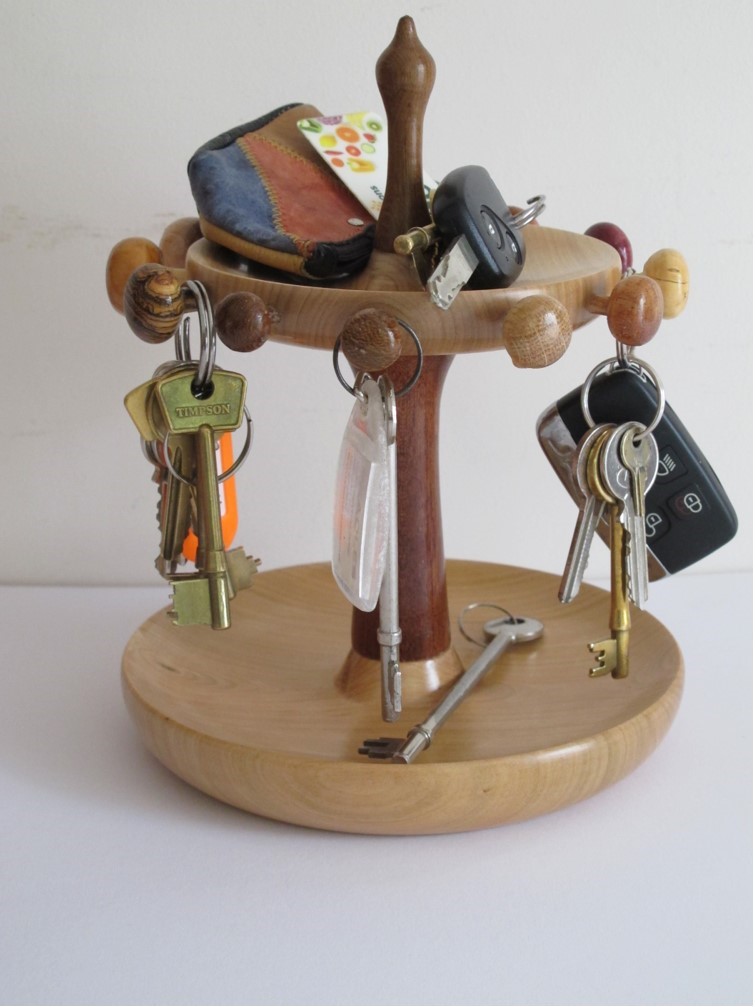 | A jolly piece, nice use of different timbers. Colour distribution a bit haphazard. Variety of timbers used for different components rather than being segmented and glued up into an entity | Definitely a useful and functional piece, as a replacement for a key bowl - each key is much easier to find and access. It certainly fits the bill. The top needs a thick rim to fix the pegs and the bottom needs weight for stability. | The central support pillar is very chunky, and all the turning is a bit amorphous. I would have liked to see more distinct transition lines between sections, as on a traditional staircase spindle. The pegs are not all the same size. Nice piece, with proportions to suit the purpose. The finial needs to be either decorative or functional. More elaborate and delicate or chunkier for a good grip. Or both! | Nice crisp tooling and a good consistent finish. Finish is good with a soft sheen and no visible sanding marks. It appears to be wax so scuffs could be easily removed. |
| Robin Barnes | 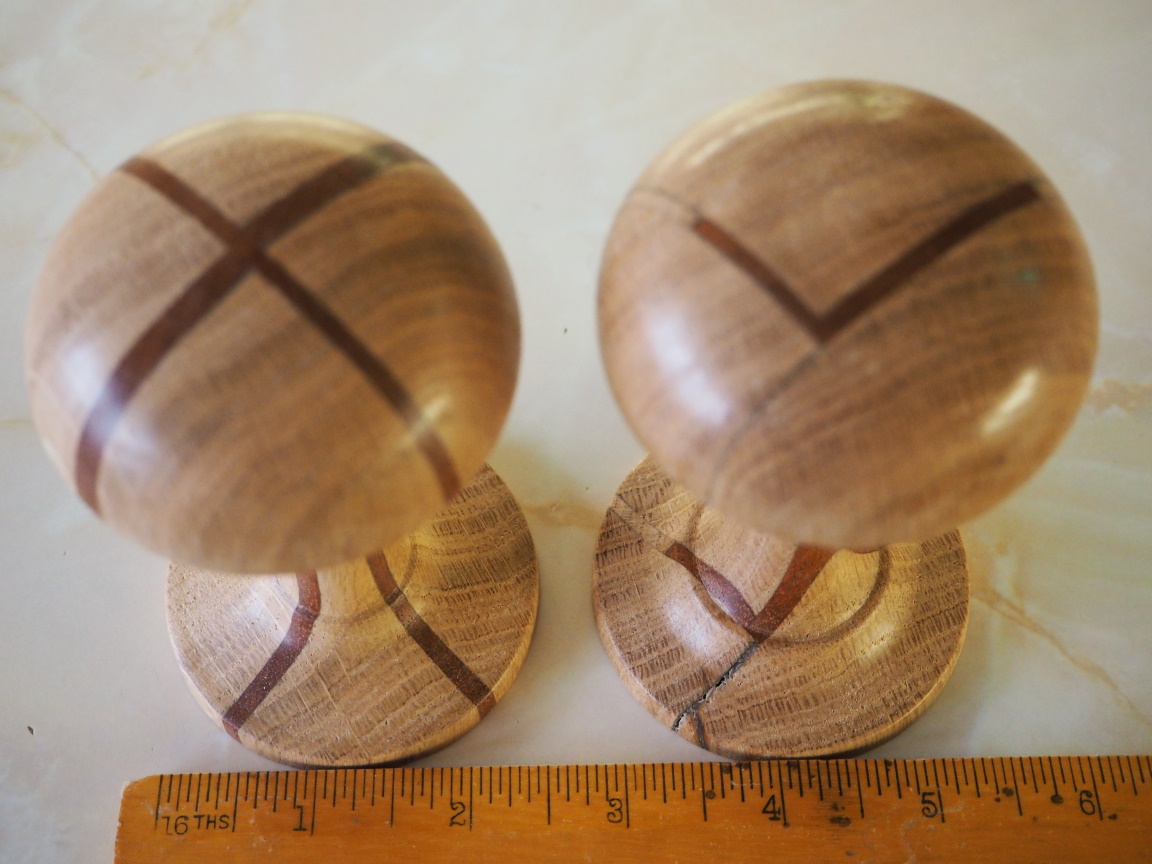 | Nice use of perpendicular glue-up, and good contrast of colour in the wood used. Each one certainly assembled as one piece, but projects like this depend on great accuracy for their appeal. | The first mushroom is fine, but the second one looks to be a mistake - I would have just entered the one! Not sure what the purpose is, beyond ornamentation. This is a decorative item and there is no function other than that. The mismatched laminations detract from this, but the interpretation of a mushroom's form is pleasing, but not the best thing to show off the laminar patterns - a vase or goblet would be better, where there is an inside as well. | The mushroom shape has been achieved, but there are distinct differences in shape between the two, especially under the cap. As noted above, the shaping is good, but let down by the laminating errors and a nasty crack, which could have been dealt with by continuing the inlay through it. Undercutting the cap would be difficult, but it is well done | Mostly good, but there is a clear defect on the second mushroom - no idea why it was entered. Oak is not easy to finish on small items due to the open grain, but can be improved by liming or using a coloured or gilt filling wax or cream. A lighter wood like sycamore would turn more easily and be a better contrast to the padauk. The crack is a problem - see above. |
| Graham Mee | 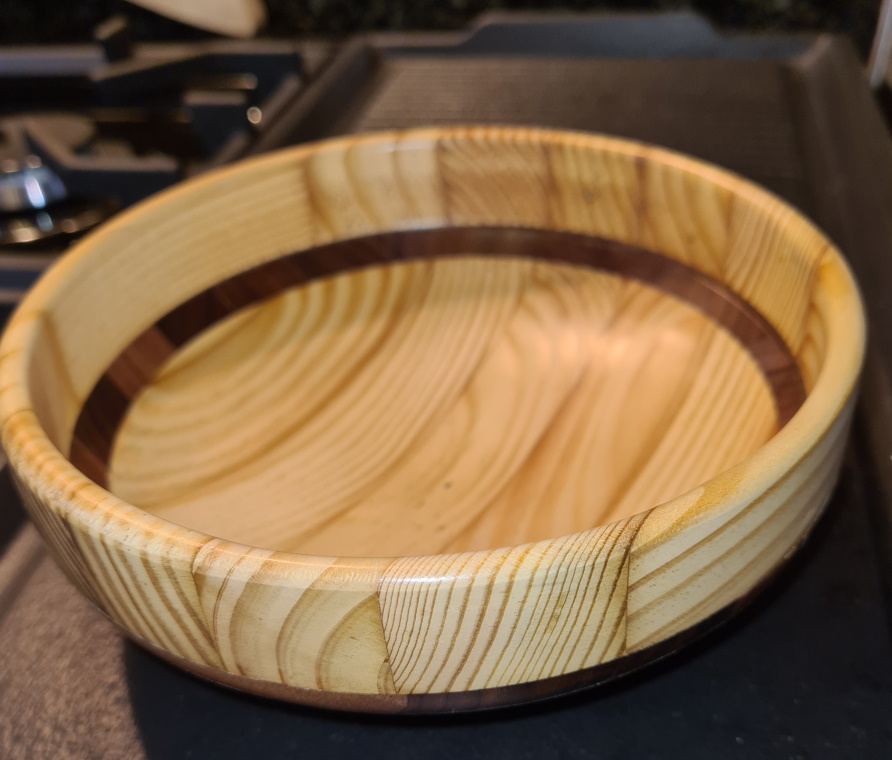 | Nice re-purposing of a basic deal wine rack into a much more elegant bowl. Not only assembled but also recycled. Good use of an old wine rack! Ingenious use of two layers of slats either side of the walnut and good alignment, though grain matching pretty well impossible. | It's a good sized bowl, but the walls are a bit chunky. I like the grain contrast between the different wood species. Nice bowl with good proportions and even thickness. Inserting a layer of veneer between the strips and use of a clear glue would prevent the darkening of the joins. | It's a very odd shape - the foot is too shallow, so the bowl doesn't sit proudly, and from the side it is hard to see the lower pine section. A crisper rim with defined edges would look better. Good lines overall, but perhaps a slight break of curve between sides and base. Reverse turning would allow the chuck recess to be tidied up | Good finish achieved, which is not easy with two such different timbers. More attention could have been paid to lining up the wood grain in the assembly. Pine is a soft and stringy, so not an easy wood to cut cleanly and finish well, but here we have success. There is sheen rather than shine - is it oil or wax? - and no tool or sanding marks. The only shortcoming is the glue staining in the joints. |
| Graham Mee (joint winner) | 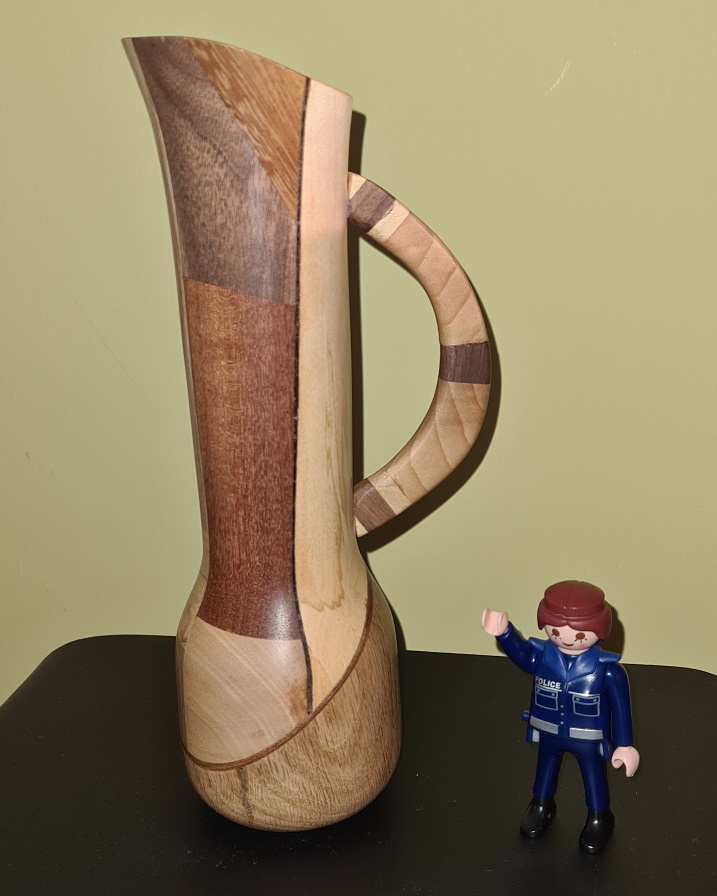 | Great idea! Very innovative - it must have been a beast to do, though… What an extravagant, exotic and Picassoesque riot of an assembly. It must have been a beast to glue up to hollow and make the handle. | Can't assess how well it would work as a real jug, but as an ornament it is striking. I doubt it could be more complex and I doubt it would hold much wine! But what an eye-opener as a conversation piece | The overall form is very nice; the curve of the handle is not smooth. The colour selection could have been mixed up better, with contrasting timbers adjacent. I wish the base were less bulbous. Tapering om down a bit further and finishing with a flange would have 'lifted' it and given a better balance. | Very nice and crisp. The whole is very nicely finished and the joints tight and cleverly picked out with veneers, which is very effective |
| Neil Innes | 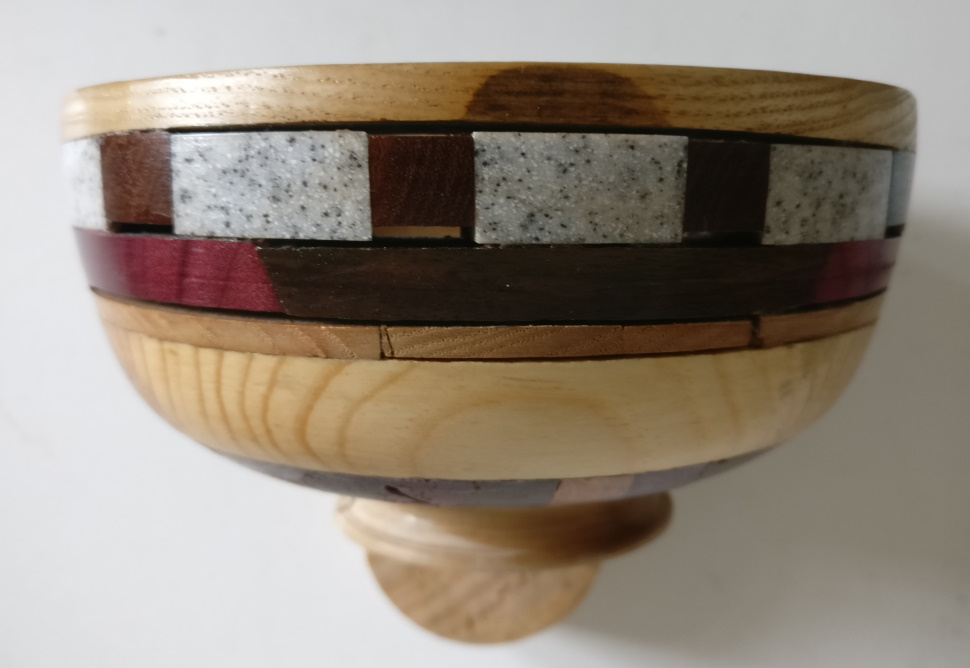 | Lots of different species, as well as corian, so a very colourful result. Choice of a bowl seems a bit safe. Here we have a bowl made up of a selection of pieces in a random layout, which meets the brief, but lacks planning. | It would work as a bowl, but it is very chunky and not particularly elegant. It looks fairly thick, but going any thinner would risk it shattering during turning. The centre of the interior lacks the symmetry of the sides. In gluing up the more pieces and the more glue you use, the more chance of slipping and malalignment. Build up gradually. | The turner has had a lot of fun, but the large gaps and glue lines detract from the appearance. I'm not even sure how it held together on the lathe! The curvature of the sides appears to be smooth. See also comment above re the interior. | Overall quite good, considering so many different timbers have been used. Some tear-out visible on the base. Shame about the crack! When gluing up multiple timbers, the most important thing is to get secure joints and that means planing up the pieces, so they fit as near perfectly as possible. This is also a safety issue. The finish looks reasonable apart from the joints. |
| Robin Barnes | 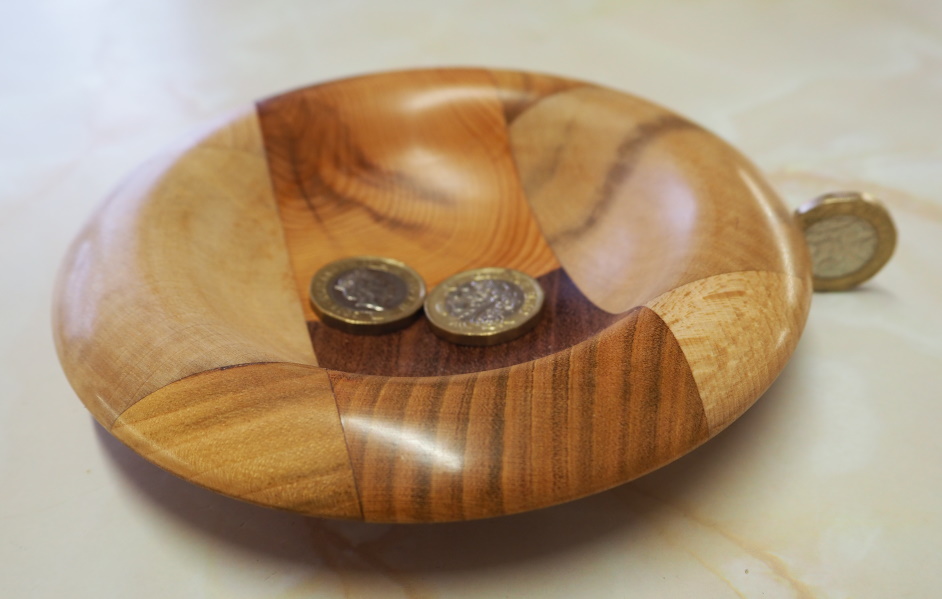 | An interesting patchwork effect from the timber combination. Choice of a bowl is a bit on the safe side. An assembly tour de force. It must have been quite tricky holding all these disparate pieces together. The joints appear to nice and snug, but would be improved with a clear drying glue and not too much of it. | It's a coin bowl, and the smooth curves make it easy for the money to be grabbed easily. A nice, curvy bowl with the timbers well laid out. Probably worth more than the £2 illustrated! | An elegant and flowing bowl - here is a good example of where curves work better than crisp edges. The trouble with using a chuck recess, even if you reverse turn and decorate it as here, is that the base is always too large to allow the outer curves to match the nice inner profile. In photo 1 it would make an attractive design if the wood in the top right sector matched the bottom left. | An impressively good finish, considering the different grain orientations in the glue-up. A nice overall finish with a pleasant sheen and no nasty marks |
| Nick Laking (joint winner) | 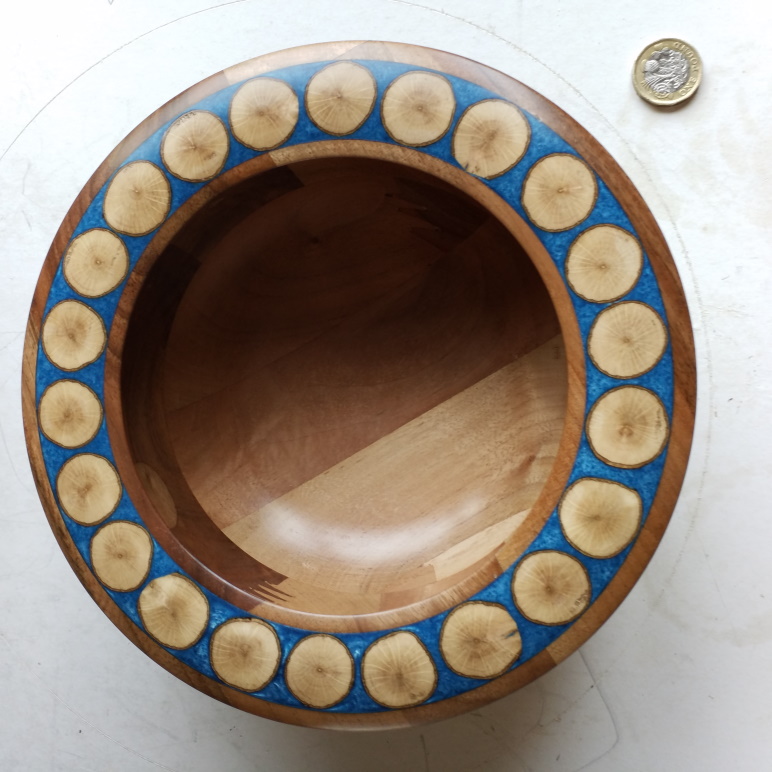 | Several different species used, but all a bit similar. Choice of a bowl is a bit safe. What sets this apart is the highlight ring of transverse branch slices in resin. A laminated bowl with well-fitting components in a random order. How was the feathered joint done, I wonder? Comb joint cutter? Pity it is off-centred on the middle block. | A bowl of significant depth, taking advantage of the construction (solid blanks of this thickness are rare). A nicely turned bowl with a rim decorated with 'oysters' set in a striking blue resin. Traditionally oysters were cut at an angle to produce an oval - more decorative and stable. Hard to judge thickness from the photos. An undercut rim could give a sharper sight line and allow for a more even wall thickness. | Fantastically elegant and swooping shape to the bowl; the foot is just the right height - not really sure how it could be better! Nice ogee curve profile. The effect would be improved if there were more thought devoted to the arrangement of the components in a logical sequence to produce a pattern | Great finish, no tear-out and just the right degree of shine. Generally good finish, but inside glossier than outside. It often happens and may be to do with the way the grain lies, so watch out for it. Yorkshire Grit and Black Bison give a consistently good result. |